
USCO Reg: Filed Nov 19, 2026-Case #1-15308105551
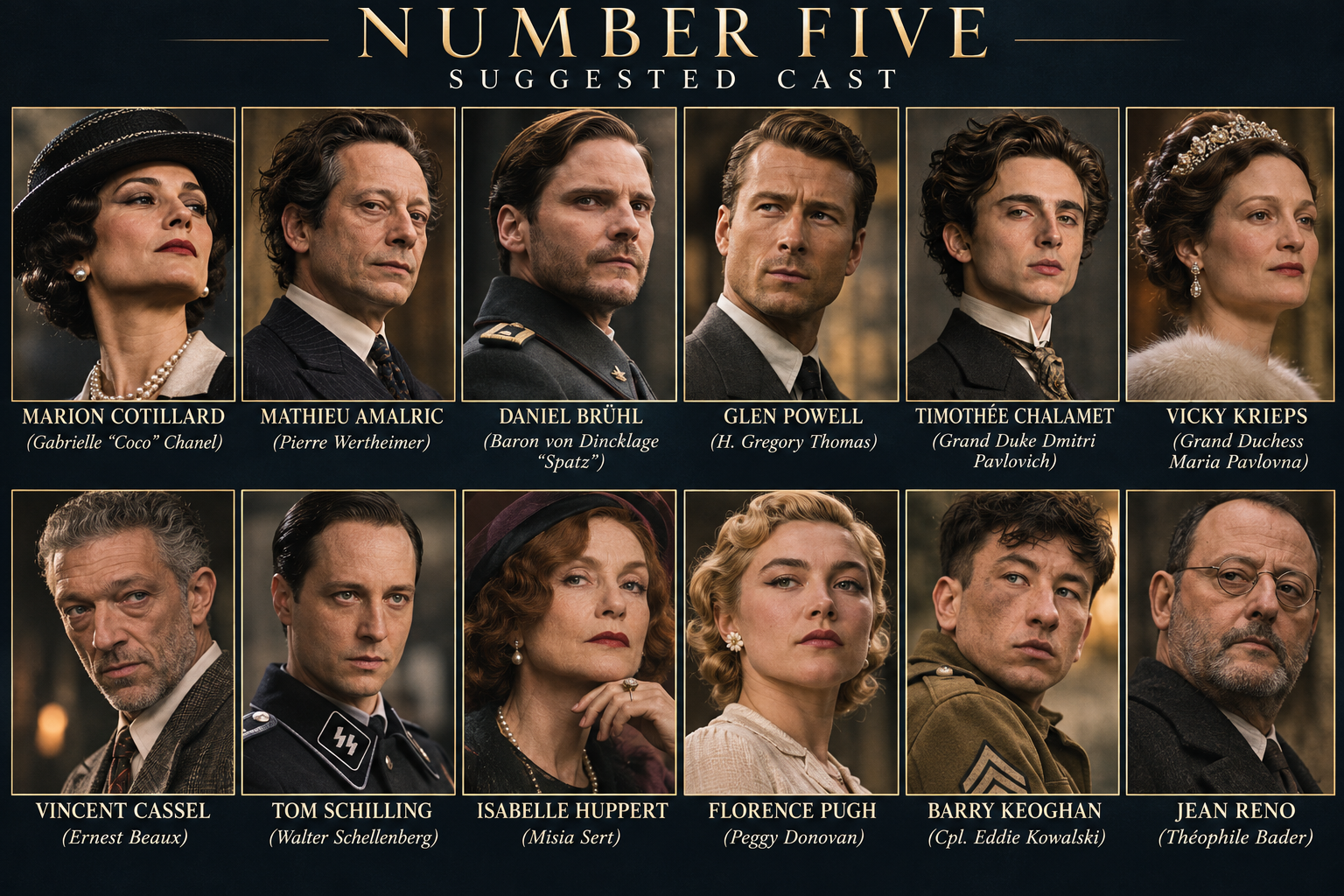
Suggested Cast
Logline
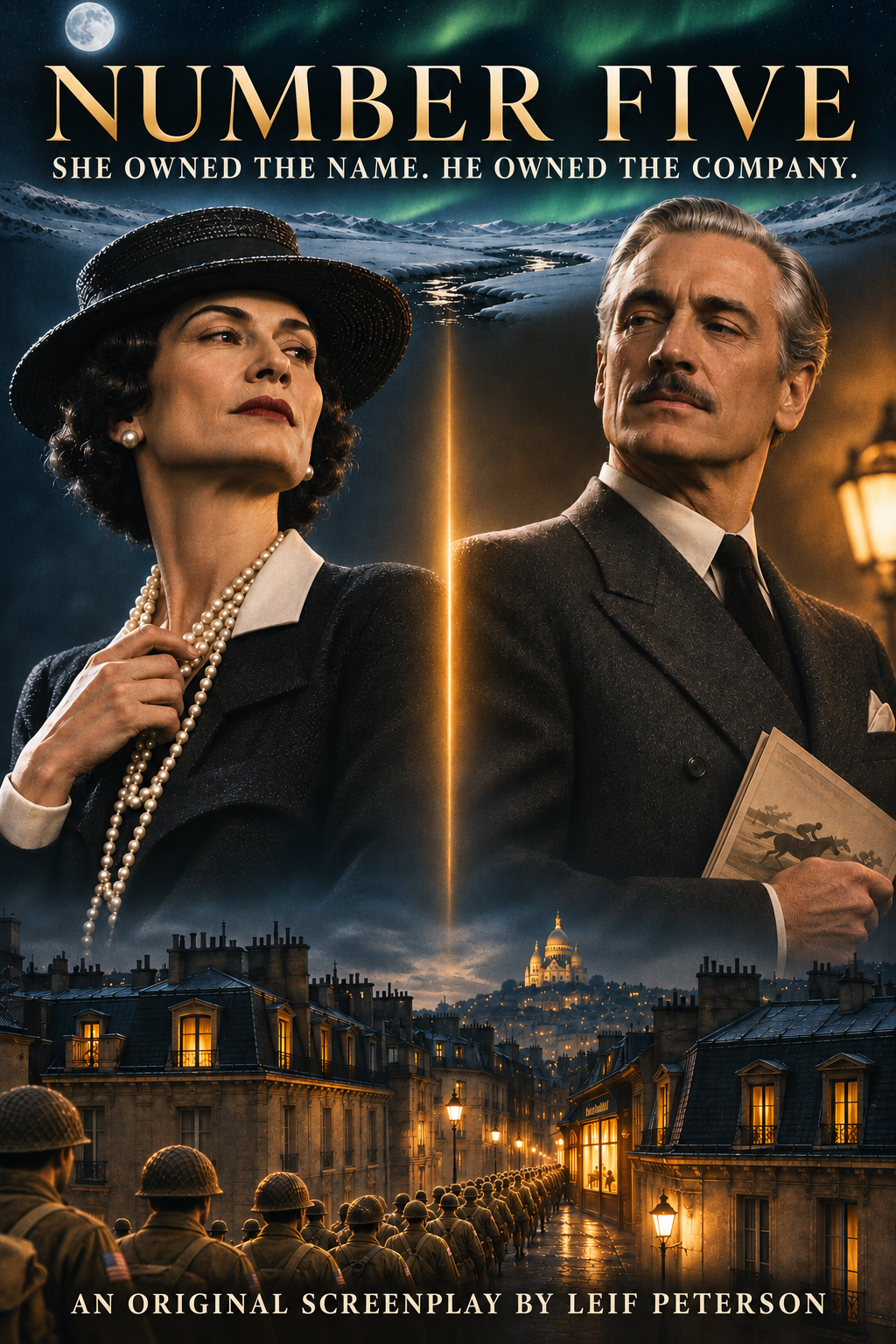
An orphan whose only inheritance was her name builds it into the most famous brand in the world, then spends thirty years at war with the businessman who owns it, through the Nazi occupation, a smuggled ton of jasmine, and a line of American soldiers down the rue Cambon.
Bio
The son of a Detroit school teacher and auto engineer with patents, Leif Peterson started attending high school summer school courses on engine mechanics in the 7th grade, and then rebuilt his mother's car engine in the 8th grade. He was a fighter pilot, has a masters degree in radiological (x-ray) physics, doctoral degree on Hiroshima & Nagasaki atomic bomb survivors, and has been a professor for more than 25 years. He published 2 scientific books and more than 100 peer-reviewed scientific papers. He is also the principal perfumer at Nodus Perfume House and writer of FORD, a biopic screenplay of Henry Ford. He is currently a lecturer in statistics at Rice University.
Synopsis
New York, 1931. Coco Chanel tours the department stores where her perfume outsells everything on the shelf, then walks into a boardroom and learns what her name is worth: ten percent. The other ninety belongs to Pierre Wertheimer, the patient racehorse owner who manufactures Chanel No. 5, and to his partner Théophile Bader. The contract she signed without reading runs in perpetuity. She smashes the coffee service and walks out with nothing.
The story drops back to 1895 and an orphanage in the abbey of Aubazine, where a nun writes "CHANEL, Gabrielle" in the register and tells her it is the only thing she owns. It follows her from a café-concert stage in Moulins to a hat shop financed by Boy Capel; to Biarritz in 1920, where the exiled Grand Duke Dmitri Pavlovich, a Romanov who survived by being banished, introduces her to the perfumer Ernest Beaux; and into Beaux's memory of a firefight in the Arctic snow and a moonlit stream that smelled of nothing at all. She chooses the fifth vial. At Longchamp in 1922 she meets Pierre, and in 1924 she signs.
When a strike and a fire gut her house in 1936, she closes the couture in 1939 and moves into the Ritz as the Germans arrive. To free her nephew from a prisoner-of-war camp she takes up with Baron von Dincklage, a charming German intelligence agent. In 1941 she tries to use the occupation's new property laws to take No. 5 back and discovers Pierre has beaten her to it: before fleeing to New York he put the company in the name of an aircraft manufacturer. From Manhattan, Pierre sends H. Gregory Thomas into Vichy France to buy hundreds of kilos of Grasse jasmine, hide it under olive oil, and run it past customs officers of four nations to a factory in Hoboken. Then he sells No. 5 to the U.S. Army's post exchanges, gambling the brand's exclusivity on ten million soldiers.
Coco's own gamble, a 1944 "peace mission" to Churchill arranged by an SS general, collapses in Madrid. At the Liberation she gives free No. 5 to every American soldier who asks, and when a mob comes for her with torches, the line of GIs is standing in the way. Arrested and released within hours, she goes into exile in Switzerland, where she launches her own red-labeled "Mademoiselle Chanel" perfumes and floods Pierre's American stores with them. In 1947 Pierre comes to Lausanne with a blind smell test, a question about 1941, and the richest settlement of her life. In 1954, at seventy, she has to ask him to fund her comeback, and he buys everything, including the name.
Producer Pitch
"NUMBER FIVE" is a screenplay for a biopic of Gabrielle "Coco" Chanel, told as a thirty-year business war with Pierre Wertheimer over who owns her name. The genre is similar to other biopics such as "Oppenheimer," "Ford v Ferrari," and "The Social Network": a founder, a partner, a product the world wants, and a contract that decides who keeps it.
The majority of scenes are based on the historical record: the 1924 Parfums Chanel agreement, the Amiot transfer, the wartime jasmine run from Grasse, No. 5 in the Army PX, the free perfume for GIs at the Liberation, the "Mademoiselle Chanel" perfumes, the 1947 settlement, and the 1954 comeback financed by Wertheimer. Research drew on biographies, histories of Chanel No. 5, and contemporary press. Some characters and scenes are fictional or composited, including the shopgirl and the GI who frame the story.
An idea for potential filming would be to start with the Liberation sequence, "EXT. RUE CAMBON - EVENING," in which a mob with torches turns into the rue Cambon and finds it filled from wall to wall with American soldiers holding bottles of perfume. Another candidate is the jasmine inspection at Gibraltar, where a Royal Navy officer smells his own wedding on a tin of "olive oil."
The script closes in 1971, on Chanel's last Sunday at the Ritz, and returns to the stained glass of the abbey where she first learned that a name is the one thing no one can take from you.